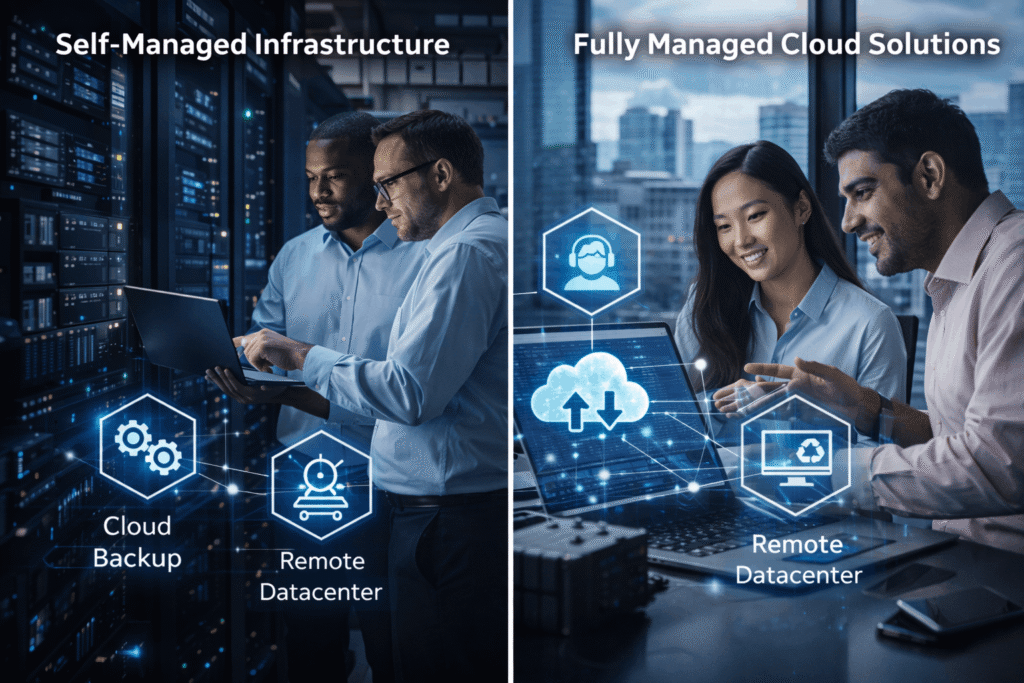

Businesses today rely heavily on digital systems to run operations, serve customers, and support growth. Traditionally, many organizations managed their own servers, storage, and applications either on-site or through basic hosting arrangements. However, a growing number of companies are now moving toward fully managed cloud solutions instead of maintaining self-managed infrastructure.
This comparative guide explains the key differences between self-managed environments and fully managed cloud solutions, and why the shift continues to accelerate.
Infrastructure Management Responsibility
With self-managed infrastructure, internal IT teams are responsible for maintaining servers, operating systems, storage, backups, and network configurations. This includes updates, troubleshooting, and capacity planning.
Fully managed cloud solutions transfer these responsibilities to a managed service provider. The provider monitors performance, applies updates, and maintains system availability.
Verdict: Fully managed cloud reduces internal workload.
Cost Structure and Predictability
Self-managed environments involve capital expenses such as hardware purchases, data centre space, and replacement cycles. Unexpected failures can introduce unplanned costs.
Fully managed cloud solutions use predictable monthly operating expenses. Businesses pay for the resources they use, along with management services.
Verdict: Managed cloud offers better cost predictability.
Scalability and Flexibility
Scaling self-managed infrastructure often requires purchasing new hardware, which takes time and budget.
Managed cloud platforms allow businesses to increase or decrease resources quickly as needs change.
Verdict: Managed cloud provides faster scalability.
Security and Compliance
Self-managed environments require in-house expertise to handle firewalls, patching, endpoint protection, encryption, and compliance requirements.
Fully managed cloud solutions include built-in security monitoring, patch management, and compliance support.
Verdict: Managed cloud strengthens security posture.
Reliability and Uptime
Self-managed systems depend on internal redundancy planning. Hardware failures can cause extended downtime.
Managed cloud providers operate redundant infrastructure with high availability designs.
Verdict: Managed cloud improves reliability.
Performance Optimization
Self-managed systems rely on internal teams to tune performance.
Managed cloud services continuously optimize storage, compute, and network performance.
Verdict: Managed cloud delivers consistent performance.
Internal IT Focus
Self-managed infrastructure consumes significant IT time.
Fully managed cloud frees IT teams to focus on business initiatives.
Verdict: Managed cloud enables strategic IT.
Final Comparison
| Factor | Self-Managed | Fully Managed Cloud |
| Management effort | High | Low |
| Scalability | Slow | Fast |
| Security coverage | Variable | Comprehensive |
| Cost predictability | Low | High |
| Reliability | Depends on internal design | High availability |
Conclusion
Businesses are moving to fully managed cloud solutions because they offer easier management, predictable costs, improved security, and scalable infrastructure. Compared to self-managed environments, managed cloud delivers a more efficient and resilient foundation for modern operations.