
Most sanitary failures trace back to design choices, not cleaning shortcuts. In food production, a conveyor is a food contact surface and a sanitation liability before it is a transport device. An industrial conveyor manufacturer that treats hygiene as a design input, not a spec added later, can make the difference between a line sanitation team’s sign-off being fast and one they fight every shift.
People Also Ask
What makes a conveyor sanitary rather than only washdown rated?
Sanitary conveyors require special design to ensure welds, drains, and overall framing do not collect bacteria.
Does upgrading an existing conveyor for washdown compliance require a full replacement?
You may not need to replace your current conveyor to upgrade it to washdown standards. Adding retractable frames and changeable belting, along with additional drains, can often make a current conveyor frame washdown-compliant.
What is the difference between clean-in-place and manual teardown cleaning?
Clean-in-place washing systems utilize specific spray patterns to clean conveyors during the wash cycle, making them ideal for conveying systems that run a continuous wet product. Manual teardown cleaning is usually utilized on lines that contain multiple products or allergens.
Why Food Plants Judge Conveyors On Cleanability First
A conveyor operating at rated speed still fails an audit when a sanitation team can’t see or reach every surface and inside the wash window.
Plants evaluate equipment by how quickly they can complete a food safety check, not just throughput. A washdown conveyor that is not designed for this requirement creates a permanent labour cost, one shift at a time.
Open Frame Construction And Line Of Sight To Every Surface
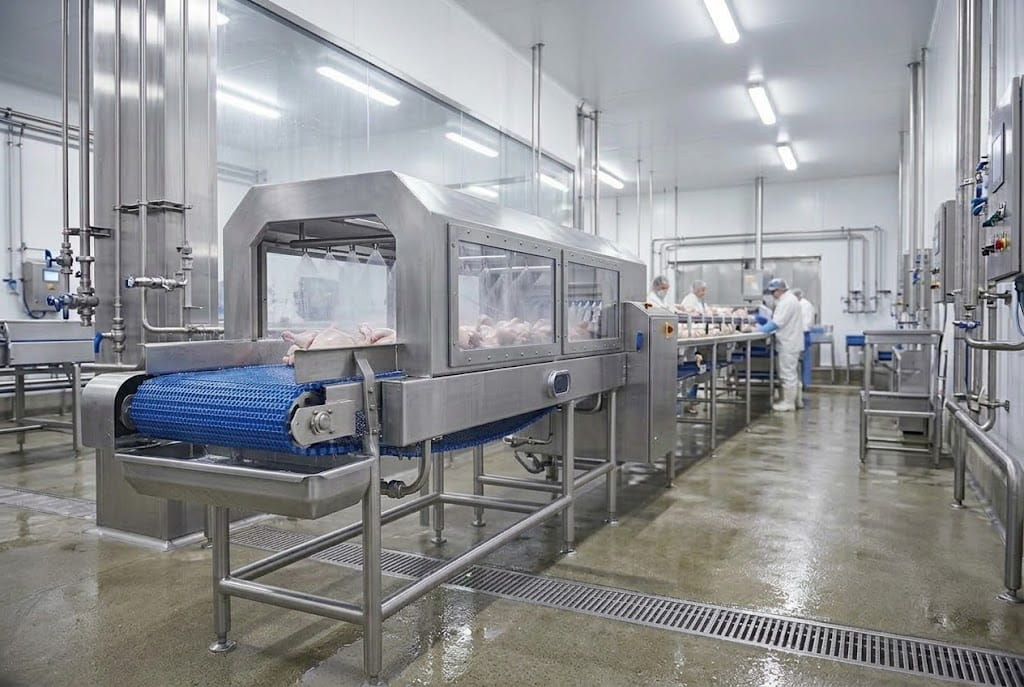
Open frame construction lets a sanitation crew see contamination risk directly instead of guessing where residue collects. Skeleton tube supports, exposed structural members, and unobstructed undersides give a food-grade conveyor its hygienic foundation.
Closed frames hide problems. Open ones expose them early, before they become a recall conversation.
Why Hollow Tube And Enclosed Sections Are A Problem
Hollow tube framing traps moisture and product residue where no brush or spray reaches. Once bacteria establish inside a sealed tube, plants describe it as nearly impossible to eliminate.
A stainless steel conveyor built on solid or vented structural members, instead of hollow tube, avoids a permanent harborage point no cleaning schedule can fix.
Welds, Radii And Surface Finish
Every weld is a possible flaw. Continuous, ground, polished welds eliminate that possibility, and rounded internal radii replace the right-angle crevices where residue can collect.
A rough finish gives bacteria more surface area to adhere to. Smooth, non-porous surfaces are a must for any food processing conveyor, not an option.
Drainage And Eliminating Standing Water
Standing water on a frame member or belt return is a biofilm risk that can be seen, even smelled. Include sloped surfaces, drainage channels, and frame geometry that sheds water rather than allowing it to pond in the original drawing.
CONOVEY builds elevation changes in washdown zones to direct water off the structure rather than on it.
Fastener Choice And Tool-Free Disassembly
Exposed threads and standard nuts trap residue in ways smooth caps and sanitary fasteners do not. Tool-free disassembly speeds up teardown and reduces the chance a crew skips a hard-to-reach fastener under time pressure. A cleanable conveyor releases its wear parts quickly, without a toolbox standing in the way.
Belt And Chain Selection For Wet Environments
Belt and chain configuration selection for washdown environments varies significantly from a dry line.
A modular plastic chain resists corrosion and buildup that a fabric belt seam may suffer from, and individual segments are easy to replace rather than replacing the entire belt.
Chemical exposure, wash water temperature, and product residue affect which chain type is best suited for repeated caustic washes.
Bearings, Seals, and Wash-Rated Motors
Sealed, sanitary bearings with welded bungs and pop-out rollers eliminate grease points and lubrication pockets which trap contamination.
Motors and gearboxes require a washdown rating compatible with the spray pressure and chemical concentration they face daily, rather than a dry-duty motor pressed into service simply because it was available.
Retractable And Quick Release Designs For Access
Sections which retract or release without disassembling the full frame give sanitation crews access to hidden zones without a full line shutdown.
Pop-out return rollers and open channel legs, features CONOVEY builds into its sanitary Activated Roller Belt conveyors, answer this access problem directly.
Designing For Clean-In-Place Against Full Teardown
Clean-in-place capability is ideal for continuous wet processes where a consistent spray pattern covers all surfaces. Full teardown is best for lines that process multiple products or allergens on the same equipment.
Make the decision during design, as retrofitting CIP piping onto a manual teardown frame rarely delivers the same results as designing it into the system from the start.
Sanitary Design Standards Food Plants Reference
Plants commonly benchmark hygienic conveyor design against 3-A Sanitary Standards, the EHEDG guideline on belt conveyor hygiene published in 2016, and BISSC for bakery lines. These standards target the same root issues covered above: hollow framing, weld quality, drainage, and surface finish. Referencing them early narrows design decisions, rather than correcting them after fabrication.
Allergen Changeover and Cross-Contamination Control
Lines running multiple allergens through shared equipment need conveyors built for fast, complete changeover. Swappable belts, quick-release guide rails, and open-frame access shorten changeover time and reduce residue a rushed cleaning cycle might miss. A sanitary conveyor manufacturer designs for changeover as a recurring event, not an exception.
Cold, Wet And Freezer Environments
Freezer/cold chain environments introduce condensation, ice and other challenges to sanitary applications.
Positive Drive Spiral technology, designed to run at reduced tension, resists cold-chain, wet-cycling environments better than traditional slip-drive technologies, which exhibit chain elongation in such service conditions.
Choose materials and designs that accommodate the transition from wash to freeze.
What Sanitation Teams Should Review Before Sign-Off
Before signing off on a new line, sanitation teams need to run a full wash cycle to confirm no standing water remains.
To confirm all welds and radii are accessible to a brush or spray, ensure there is no hollow framing within your product area, and time a full teardown against the plant’s actual wash window.
A Sanitary Design Checklist For Your Next Line
Open-end construction with maximum lines of sight. No hidden or enclosed structural tubes in product zones.
Continuous ground welds and internally rounded radii throughout. Drainage geometry proven in a live wash test, not on paper. Tool-free fasteners on all wear parts. Belt or chain rated for the chemistry in use.
The Design Stage Decides Sanitary Performance
Sanitary performance gets decided at the drawing stage, not the mop bucket. An industrial conveyor manufacturer in Canada or anywhere else earns trust from food plants by building drainage, open frames, and tool-free access into the original design, so cleaning becomes fast and repeatable instead of a daily fight against the equipment itself.
Ready to design a conveyor around your product instead of forcing your product around a catalogue part? Contact the CONOVEY team at sales@conovey.com or 1 (844) 876 8889 to start the conversation.