
Introduction
Urban development across Canada places acoustic consulting engineers at the centre of project approvals, community relations, and regulatory compliance. Selecting top Canadian consultants for urban noise impact assessments is a decision that shapes whether a commercial, infrastructure, or large-scale residential development proceeds on schedule or faces avoidable dispute.
Canadian municipalities enforce rigorous noise and vibration standards. When acoustic complexity is underestimated, the consequences can include approval delays, costly redesigns, and objections from nearby stakeholders. Developers, contractors, and project planners benefit from engaging qualified acoustical engineering expertise early, before site planning, equipment placement, and construction sequencing are fixed.
Why Early Acoustic Planning Matters
Proper acoustic planning is not a compliance checkbox. It is a foundational engineering discipline that supports approval certainty, constructible design, and long-term asset performance.
Early involvement helps project teams:
- Identify noise and vibration risks before construction begins
- Align project design with municipal and provincial requirements
- Reduce the chance of repeated regulatory submissions
- Plan practical mitigation before retrofits become necessary
- Support clearer communication with reviewers, owners, and contractors
Why Developers Trust Consultants for Urban Noise Impact Assessments
Canadian regulatory frameworks governing noise and vibration require precise mathematical modelling, field measurement programs, and clear interpretation of municipal and provincial requirements. Experienced consulting engineers understand how environmental legislation interacts with municipal noise bylaws, and they structure assessment methodologies accordingly.
This combination of regulatory knowledge and acoustic science helps project teams prepare stronger submissions. It also reduces the risk of repeated review cycles caused by incomplete data, unsupported assumptions, or unclear mitigation strategies.
The Value of Proactive Mitigation Design
Proactive mitigation design is one of the clearest differences between a general consultant and a qualified acoustic consulting engineer. When vibration transmission risks or airborne noise exceedances are identified during predictive modelling, design teams can respond before construction begins.
This may involve reviewing:
- Façade assemblies
- Rooftop mechanical equipment locations
- Loading area layouts
- Outdoor amenity exposure
- Structural isolation details
- Construction vibration controls
- Operational noise management measures
Addressing these issues at the design stage is materially less disruptive than retrofitting completed structures. Developers working on transit-adjacent mixed-use projects, wind energy infrastructure, commercial facilities, or dense multi-unit residential developments benefit from this front-loaded engineering discipline.
Evaluating Consultants for Urban Noise Impact Assessments
Reliable firms deploy predictive acoustic modelling tools capable of simulating sound exposure across complex urban conditions before construction begins. This capability is especially relevant in dense Canadian environments where building geometry, transit corridors, rooftop equipment, loading areas, and industrial adjacencies can create layered noise source interactions.
A consultant who relies only on post-construction measurement may not provide the engineering foresight that complex projects require. Strong acoustic consulting should help project teams understand risk before approvals, procurement, and construction sequencing are locked.
Key Evaluation Factors
When comparing consultants, project teams should look beyond basic measurement capability. The strongest acoustic consulting partners bring technical depth, regulatory familiarity, and practical construction awareness.
Key evaluation factors include:
- Experience with commercial construction, infrastructure, and large-scale residential developments
- Technical capability in noise and vibration analysis
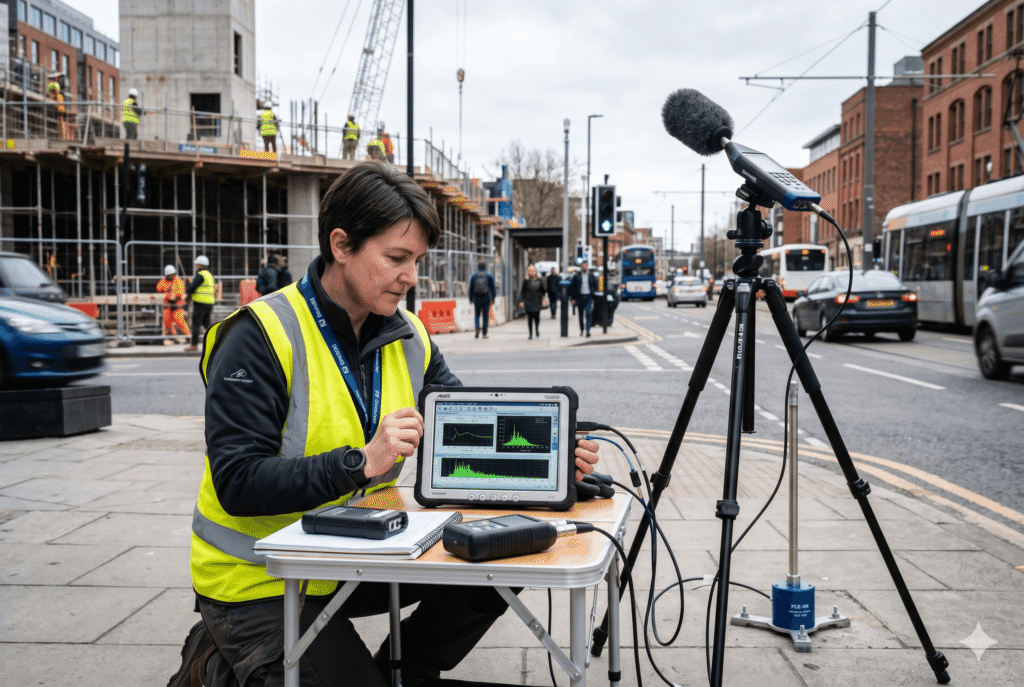
- Acoustic monitoring and baseline measurement expertise
- Knowledge of municipal noise guidelines and regulatory review processes
- Ability to prepare clear, regulator-facing documentation
- Experience with non-finite projects such as wind farms
- Practical mitigation strategies that can be coordinated with design and construction teams
Why Portfolio Depth Matters
Portfolio depth is important because urban noise and vibration issues rarely follow a single pattern. A consultant may need to address environmental noise, construction activity, mechanical systems, transportation corridors, façade exposure, and vibration-sensitive structures within the same project.
Comprehensive experience should span:
- Vibration monitoring programs
- Environmental acoustic testing
- Construction noise management plans
- Compliance support
- Predictive modelling
- Expert reporting for approvals or disputes
Firms that have navigated multi-phase urban developments demonstrate the project management discipline needed to coordinate from initial baseline measurement through final implementation and regulatory sign-off.
Communication and Reporting Standards
Clear, technically precise communication is essential. Reports must support engineering teams, municipal reviewers, owners, and contractors with defensible findings and practical recommendations.
A strong consultant should provide documentation that is:
- Technically accurate
- Easy for reviewers to follow
- Connected to applicable standards or guidelines
- Supported by measurement data or modelling logic
- Practical for design and construction teams to implement
This reporting quality can directly affect approval timelines and the strength of the project’s compliance position.
Getting Started with Consultants for Urban Noise Impact Assessments
Valcoustics Canada Ltd. delivers acoustical engineering support across complex urban development projects, including commercial construction, infrastructure programs, wind farms, and large-scale residential developments. As a qualified consulting engineer, Valcoustics brings the technical credentials and regulatory familiarity project leaders require when navigating Canadian noise and vibration compliance requirements.
Engaging the Valcoustics team early in the planning phase allows acoustic considerations to be integrated into design decisions rather than appended as late-stage corrections. Early involvement can streamline the approval process, reduce the likelihood of costly design revisions, and position the project for a more defensible regulatory submission.
Project leaders assessing top Canadian consultants for urban noise impact assessments should prioritize engineering depth, regulatory clarity, monitoring capability, and practical mitigation planning. To align acoustic strategy with project approvals, compliance requirements, and long-term asset performance, request a consultation with Valcoustics Canada Ltd.