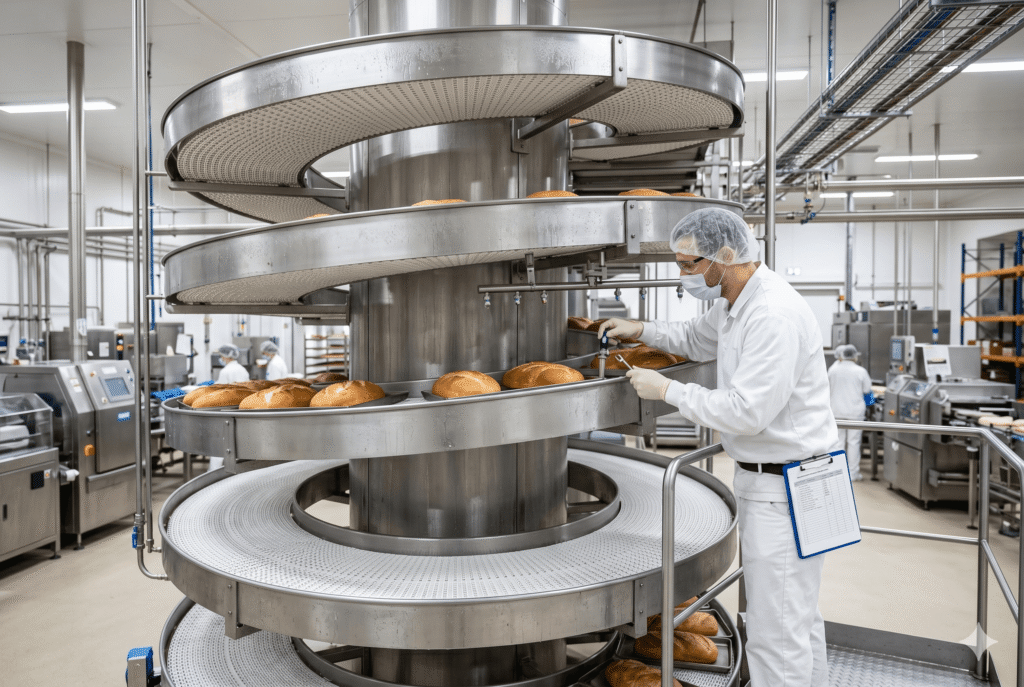

High-speed food processing environments require strict control over sanitation, thermal performance, and equipment reliability. A spiral cooling conveyor must operate consistently under demanding conditions while meeting hygiene standards and maintaining product quality. Inefficient design or poor maintenance practices can introduce contamination risks, reduce throughput, and increase operational downtime.
A structured optimization approach ensures that each element of the conveyor contributes to safe and efficient processing. The following steps outline key considerations for improving performance and maintaining food safety.
1. Assess Spiral Cooling Conveyor Belt Material for Sanitation
Stainless Steel Versus Modular Plastic Belting
Belt material plays a central role in determining sanitation efficiency. Modular plastic belting is often selected for its smooth surface geometry, which reduces the number of crevices where food residue can accumulate. This supports more effective cleaning between production cycles.
Stainless steel remains suitable for high-temperature or abrasive applications. However, in wet cooling environments, plastic modular belts are frequently associated with improved cleanability due to reduced surface complexity.
Key evaluation factors include:
- Surface smoothness and resistance to residue buildup
- Compatibility with cleaning chemicals
- Structural performance under continuous load
- Availability of food-contact compliance documentation
2. Upgrade to Positive Drive Technology for Spiral Conveyors
Reducing Belt Tension and Harborage Points
Positive drive technology engages the belt directly using mechanical features such as tabs or ribs. This reduces reliance on friction-based movement and supports more consistent belt tracking. Lower belt tension can reduce mechanical stress and extend component lifespan.
Reduced contact pressure also limits areas where residue may become trapped, supporting improved sanitation outcomes. Facilities upgrading from friction-driven configurations often achieve more stable product handling and reduced maintenance interruptions.
Key considerations:
- Suitable for high-throughput applications requiring consistent product orientation
- Less effective for low-demand operations where existing configurations meet requirements
- Higher initial investment with potential long-term maintenance benefits
3. Implement Clean-In-Place Protocols for Spiral Cooling Conveyors
Automating Washdown Processes
Manual cleaning introduces variability and may not consistently remove all contaminants. Clean-in-place protocols automate rinse, chemical application, and final wash stages, improving consistency across cleaning cycles.
Effective system design includes:
- Spray coverage across belt surfaces and structural elements
- Controlled flow rates to prevent pooling
- Integration with sanitation schedules
Automated cleaning processes are often associated with reduced labor variability and improved hygiene consistency in high-throughput facilities. This is especially important when food processors compare equipment options from spiral freezer manufacturers and cooling conveyor providers.
4. Evaluate Hygienic Design Standards for Spiral Cooling Conveyors
Open Designs and Drainage Optimization
Hygienic design focuses on eliminating areas where moisture and residue can accumulate. Open structural configurations improve accessibility for cleaning, while sloped surfaces promote effective drainage during washdown.
Design features that support sanitation include:
- Minimal enclosed areas
- Reduced number of fasteners in product zones
- Smooth transitions between structural elements
Alignment with recognized hygienic design practices supports compliance with food safety standards and improves long-term reliability.
5. Optimize Thermal Dynamics Within Spiral Cooling Conveyors
Airflow Patterns and Dwell Time Control
Thermal performance depends on how effectively airflow interacts with product surfaces across all levels of the spiral. Uniform airflow distribution supports consistent cooling and prevents uneven temperature zones.
Dwell time must be calibrated based on product characteristics, including moisture content and heat transfer requirements. Accurate control of belt speed and airflow conditions helps maintain product quality while supporting food safety objectives.
Operational considerations include:
- Airflow distribution across all conveyor tiers
- Alignment of dwell time with product core temperature targets
- Management of condensation to prevent moisture accumulation
6. Select the Right Approach for Compliance and Performance
Drive technology, structural design, and sanitation methods must align with production requirements and regulatory expectations. Positive drive configurations support tension control and improved hygiene, while optimized airflow systems contribute to energy efficiency and product consistency.
Retrofitting legacy equipment with updated configurations can improve long-term operational performance by reducing maintenance demands and supporting consistent cleaning practices.
Conclusion
Optimizing a spiral cooling conveyor for food safety requires careful evaluation of materials, drive technology, hygienic design, and thermal performance. Each factor contributes to maintaining consistent product quality, reducing contamination risk, and supporting reliable operation in high-speed environments.
For facilities focused on improving sanitation and operational efficiency, Conovey provides engineering expertise to support system optimization and performance alignment. Connect with Conovey to evaluate the current spiral conveyor configuration and implement strategies that improve hygiene, reliability, and long-term operational performance.