
Every commercial and industrial development operates within a complex acoustic environment in which sound can affect compliance, performance, and compatibility with surrounding land use. A structured noise impact assessment is often the starting point for understanding how a project will interact with its acoustic surroundings and what design adjustments are required to meet regulatory expectations. Without this foundation, design decisions risk being based on assumptions rather than measurable conditions.
As development density increases and regulatory standards become more stringent, the role of acoustic data has expanded beyond compliance. Noise testing now informs planning, engineering, and operational strategies, ensuring that projects are designed with long-term performance and environmental considerations in mind.
People Also Ask
What is the purpose of a noise impact assessment in development projects?
A noise impact assessment evaluates how a project will affect surrounding sound levels and determines the mitigation measures required to meet regulatory standards.
How do noise testing services influence building design?
Noise testing provides data to inform decisions on layout, materials, equipment placement, and mitigation strategies, ensuring compliance and optimal acoustic performance.
Why Noise Testing Is Critical in Modern Development Projects
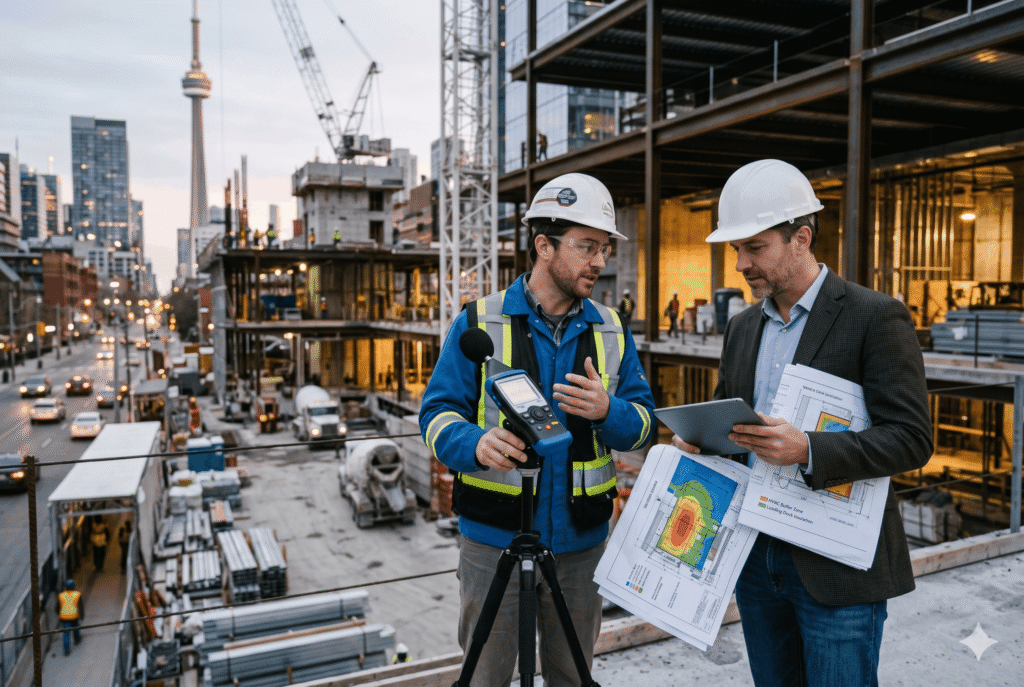
Noise testing provides the quantitative data required to evaluate how sound behaves across a project site and its surrounding areas. In commercial and industrial developments, noise sources may include mechanical systems, production equipment, transportation activity, and external environmental factors.
Without accurate measurement, it becomes difficult to determine whether a project will meet permissible limits or require mitigation measures. Testing allows project teams to identify potential risks early, reducing the likelihood of redesign, delays, or compliance challenges.
Moreover, noise testing supports coordination across disciplines. Architects, engineers, and planners rely on this data to align building systems, layouts, and materials with acoustic performance targets.
Establishing Accurate Baseline Conditions
Baseline noise measurements define the existing acoustic environment before development begins. These measurements capture ambient noise levels, temporal variations, and dominant sound sources across different times of day.
Establishing baseline conditions is critical for differentiating between pre-existing noise and project-related impacts. It also provides a reference point for evaluating compliance once the project is operational.
Accurate baseline data ensures that mitigation strategies are appropriately scaled. Overestimating background noise can result in insufficient controls, while underestimating it may lead to unnecessary design complexity and cost.
Guiding Design Through Data-Driven Insights
Noise testing translates acoustic conditions into actionable design inputs. Predictive modeling, informed by measured data, allows engineers to simulate how sound will propagate within and beyond the project site.
These insights influence key design decisions such as building orientation, façade construction, equipment placement, and site layout. For industrial facilities, this may include positioning high-noise equipment away from sensitive receptors or integrating enclosures to control emissions.
Noise control consultants play a central role in interpreting testing data and aligning it with engineering and architectural objectives. Their input ensures that acoustic performance is integrated into the design rather than treated as an afterthought.
Optimizing Noise Mitigation Strategies
Effective mitigation strategies depend on accurate measurement and analysis. Noise testing helps determine the type, scale, and placement of mitigation measures required to achieve compliance.
Common solutions include acoustic barriers, enclosures, silencers, vibration isolation systems, and material selection tailored to specific noise frequencies. The effectiveness of these solutions depends on their alignment with measured data and modeled predictions.
By optimizing mitigation strategies during the design phase, projects avoid reactive modifications that can disrupt schedules and increase costs. This approach ensures that acoustic performance is both reliable and cost-effective over the project lifecycle.
Supporting Compliance and Approval Processes
Regulatory approval for commercial and industrial developments often depends on demonstrating compliance with environmental noise standards. Noise testing provides the evidence required to support these approvals.
Detailed reports, supported by measured data and predictive analysis, form the basis of submissions to regulatory authorities. These reports outline expected noise levels, mitigation strategies, and compliance pathways.
Transparent and well-documented testing reduces the risk of approval delays and strengthens stakeholder confidence. It also provides a defensible record in the event of disputes or compliance reviews.
Validating Performance Post-Construction
Post-construction testing verifies that the built environment performs as intended. This phase confirms that noise levels align with predicted outcomes and regulatory requirements.
Validation is particularly important for complex industrial systems where operational conditions may differ from initial assumptions. Testing ensures that mitigation measures are functioning effectively and identifies any adjustments required to maintain compliance.
Ongoing monitoring may also be implemented for facilities with variable operations or evolving surrounding environments. This ensures continued alignment with regulatory standards and operational expectations.
Turning Data into Smarter Acoustic Design Decisions
Noise testing has become an integral component of modern commercial and industrial development. It transforms acoustic considerations from assumptions into measurable, actionable data that informs every stage of a project.
From baseline assessment to post-construction validation, structured acoustic analysis supports better decision-making, reduces risk, and ensures compliance. Integrating testing into the design process allows projects to achieve performance objectives without costly redesign or operational limitations.
Valcoustics Canada Ltd delivers engineering-led acoustic solutions that support commercial and industrial developments throughout the project lifecycle. By combining detailed analysis, predictive modeling, and compliance-focused strategies, Valcoustics helps project teams make informed design decisions backed by reliable data. Incorporating advanced noise testing services, Valcoustics ensures that developments meet regulatory standards while maintaining long-term operational performance. Connect with Valcoustics to implement data-driven acoustic strategies for complex projects.