
Industrial facilities rely on reliable storage systems to safely handle aggressive liquids. Selecting the right tank supplier is not simply a purchasing decision. It directly affects operational safety, regulatory compliance, and long-term maintenance costs. Businesses evaluating chemical storage tanks should focus on manufacturers that combine engineering expertise, material knowledge, and documented quality control.
At Belding Tank Technologies, engineered tank systems are designed to meet strict performance and compliance requirements across chemical processing, wastewater treatment, and industrial manufacturing.
Below are seven key features that define dependable chemical storage tank manufacturers.
1. Proven Expertise With Corrosive Materials
Chemical storage requires specialized material knowledge. Acids, solvents, and alkalis can degrade standard materials if compatibility is not carefully evaluated. Experienced chemical tank manufacturers understand how different chemicals interact with structural materials and resin systems.
Manufacturers with proven expertise can recommend appropriate tank materials based on chemical concentration, operating temperature, and storage duration. This reduces the risk of premature tank failure and protects surrounding equipment.
2. Compatibility Testing and Resin Selection
Resin selection plays a critical role in the performance of fiberglass tanks. Different resins offer varying resistance to chemical exposure, temperature changes, and environmental conditions.
Reliable manufacturers perform compatibility assessments that match the stored chemical to the correct resin formulation. Vinyl ester, epoxy, or specialized polyester resins may be selected depending on the application. This step ensures that chemical storage tanks maintain structural integrity throughout their service life.
3. QA Certifications and Documentation
Quality assurance processes confirm that tanks meet structural and regulatory requirements. Leading chemical storage tank manufacturers provide detailed documentation to support compliance and inspection processes.
Important QA elements include:
- Manufacturing certifications and material traceability
- Hydrostatic pressure testing
- Laminate thickness verification
- Structural design calculations
Facilities benefit from working with suppliers that maintain consistent documentation and testing standards.
4. Custom Fabrication Capabilities
Industrial facilities rarely operate under identical conditions. Tanks must integrate with piping systems, monitoring equipment, and facility layouts. For this reason, custom fabrication capabilities are essential.
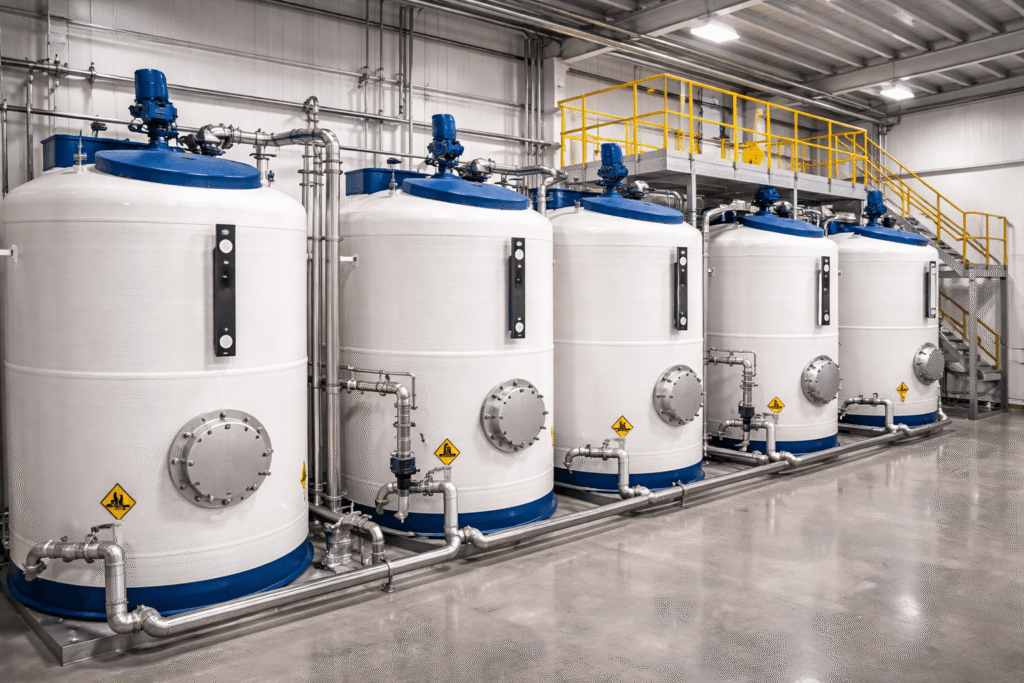
Experienced chemical tank manufacturers can produce tanks with:
- Custom nozzle placements
- Manways and access ports
- Instrumentation connections
- Secondary containment options
Custom engineering ensures that tanks align with operational processes rather than forcing facilities to adapt to standard designs.
5. Reputation and Service Support
A manufacturer’s track record often reveals its ability to deliver reliable products and services. Facilities should evaluate industry experience, client references, and long-term service capabilities.
Reliable chemical storage tank manufacturers provide ongoing technical support, including maintenance guidance and engineering consultation. This partnership approach ensures tanks continue to perform safely throughout their lifecycle.
6. Design Versatility
Different facilities require different tank configurations. Manufacturers should offer flexibility in tank geometry and construction.
Design options may include:
- Vertical tanks for space-efficient installations
- Horizontal tanks for low-profile layouts
- Double-wall tanks for enhanced containment
- Custom reinforcement for high-load environments
Versatile design capabilities allow chemical storage tanks to adapt to various industrial processes and facility constraints.
7. Delivery and Installation Logistics
Even the best tank design can fail if transportation and installation are not carefully planned. Reliable chemical tank manufacturers coordinate delivery schedules, lifting requirements, and installation guidelines.
Key logistical considerations include:
- Site access for transport equipment
- Foundation and anchoring specifications
- Handling instructions to prevent damage during installation
Manufacturers that support the full delivery and installation process help facilities avoid costly delays or structural issues.
Conclusion
Selecting the right supplier for chemical storage tanks requires careful evaluation of technical expertise, manufacturing quality, and long-term service capabilities. Experienced chemical storage tank manufacturers combine material knowledge, engineered design, and quality assurance processes to deliver safe, durable storage systems.
By partnering with established chemical tank manufacturers, facilities reduce operational risk and extend the lifespan of their storage infrastructure.
For engineered tank systems designed for demanding industrial environments, contact Belding Tank Technologies.