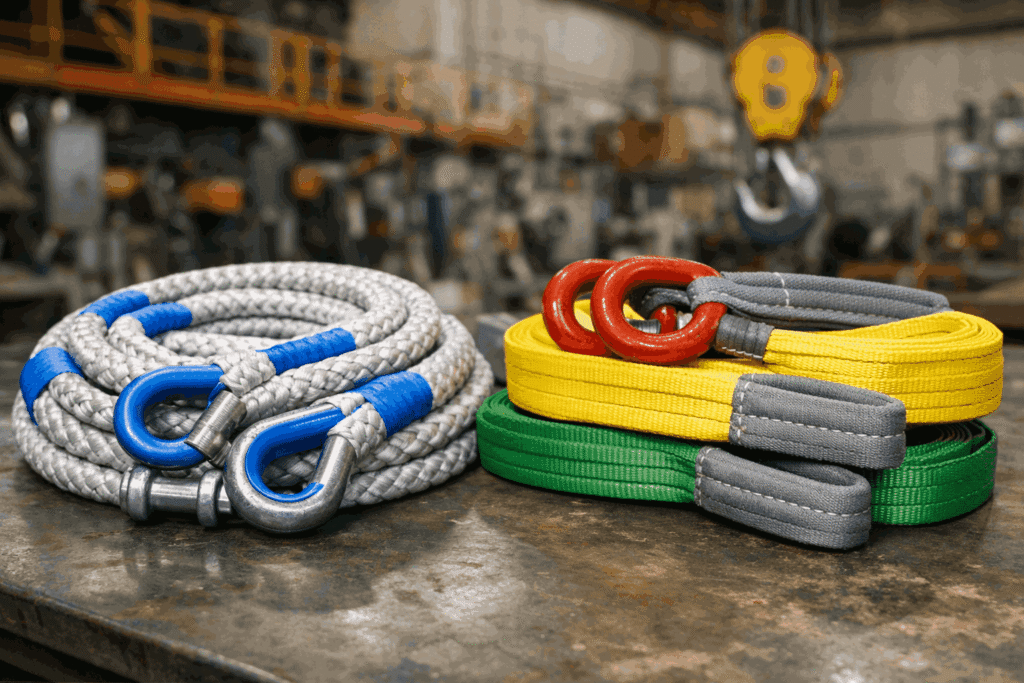

In many industrial lifting environments, protecting the load is just as important as lifting it safely. When surfaces must remain unsafely damaged or when flexibility is required around irregular shapes, synthetic slings are often preferred over chain or wire rope options. Their lighter weight, ease of handling, and surface-friendly design make them a practical choice for manufacturing, construction, and material-handling operations.
Understanding the differences between synthetic rope slings and synthetic web slings helps ensure the right sling type is selected for the load, environment, and lifting method. Murphy Industrial Products, Inc. supplies a full range of synthetic lifting solutions engineered for industrial performance.
Overview of Rope Slings – Flexibility and Choker Capability
Synthetic rope slings are constructed from braided or twisted high-strength fibers. Their round profile provides excellent flexibility, making them well-suited for wrapping around irregular or cylindrical loads.
One of the primary advantages of rope-style configurations is their ability to perform effectively in choker hitches. The rope construction allows the sling to grip loads securely without excessive flattening. This makes them useful for pipes, structural components, and machinery parts with varying shapes.
The flexibility of rope slings also reduces stress concentration at connection points. This helps maintain load balance during lifts that involve shifting or minor adjustments.
Overview of Web Slings – Wider Surface Area and Load Protection
In contrast, synthetic web slings feature flat woven webbing. Their wider surface area distributes load pressure across a broader section of the lifted object. This makes them particularly beneficial when handling delicate or finished surfaces that require protection.
Web slings are commonly used in basket and vertical hitch configurations. The flat profile improves load stability and reduces indentation on softer materials. In applications involving painted surfaces, fabricated assemblies, or finished equipment, web slings help minimize cosmetic or structural damage.
Murphy Industrial Products, Inc. provides industrial-grade web sling options designed for consistent performance in repetitive lifting environments.
Durability, Abrasion, and Moisture Resistance Comparison
Durability depends heavily on environmental conditions. Both synthetic rope slings and synthetic web slings are resistant to corrosion and many chemicals, making them suitable for indoor and moderate outdoor use.
However, web slings may be more susceptible to edge abrasion due to their flat design. Edge protection may be required when lifting loads with sharp corners. Rope slings, while flexible, can also experience internal fiber wear if dragged across rough surfaces.
Moisture resistance varies depending on material composition, but synthetic fibers generally resist mildew and rot. Proper inspection and storage remain critical for both types to maintain strength over time.
Cost, Inspection, and Replacement
From a cost perspective, both sling types offer economic advantages over heavier lifting solutions in appropriate applications. Initial pricing may vary depending on capacity and length.
Inspection practices are similar. Operators must check for cuts, fraying, heat damage, and tag visibility before each use. Damage to load-bearing fibers requires immediate removal from service.
Murphy Industrial Products, Inc. emphasizes routine inspection and timely replacement to ensure continued compliance and lifting safety.
Best Applications for Each Type
Synthetic rope slings are often preferred for irregular shapes, cylindrical loads, and choker hitch applications. Their flexibility enhances adaptability in dynamic lifting environments.
Synthetic web slings excel when load protection and surface preservation are priorities. Their wide contact area supports stable lifts of finished equipment, fabricated parts, and sensitive components.
Selecting between these sling types depends on load geometry, surface sensitivity, and environmental exposure.
Choose Based on Load Type and Environment
There is no universal solution when choosing between synthetic rope slings and synthetic web slings. Both fall under the broader category of synthetic slings, yet each offers distinct advantages.
By evaluating flexibility needs, surface protection requirements, and environmental conditions, lifting teams can select the sling that best supports safe and efficient operations. Murphy Industrial Products, Inc. continues to provide industrial lifting solutions that align with demanding performance standards across diverse applications. For more information, contact Murphy Industrial Products, Inc. now!