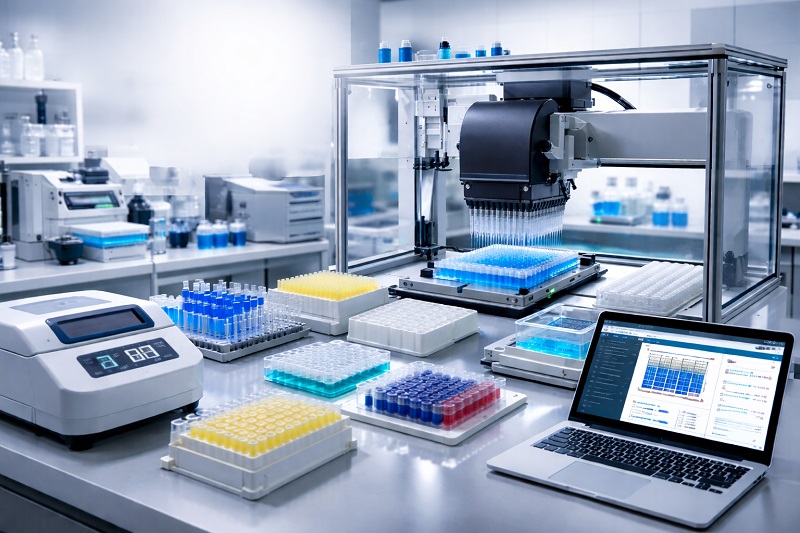

Biotech laboratories are operating under increasing pressure to deliver faster results, scale throughput, and maintain reproducibility—all while managing tighter budgets and growing complexity. Manual processes and isolated automation tools that once worked are now limiting long-term growth. As a result, many organizations are rethinking how they approach automation—not just as a short-term upgrade, but as a strategic investment.
Labs are moving away from piecemeal solutions and toward laboratory automation solutions that can evolve alongside their research pipelines. Choosing the right automation strategy today is critical to ensuring your facility remains competitive, flexible, and efficient well into the future.
Defining Future-Ready Lab Automation Solutions
A single robot or instrument does not define future-ready automation. It’s defined by how well systems work together. Laboratory automation solutions in modern biotech facilities must support integration, scalability, and adaptability across workflows.
A future-ready solution typically includes:
- Software that orchestrates instruments rather than managing them in isolation
- Hardware that supports modular expansion instead of fixed configurations
- Integration with data systems and scheduling platforms
- The ability to adjust workflows without reengineering the entire lab
Thr focus is on helping labs build connected environments where automation supports scientific goals—not the other way around.
Trends in Laboratory Robotics and Automation
Several key trends are shaping the future of laboratory robotics and automation:
Flexibility: Flexibility is becoming non-negotiable. Labs want robotics that can handle multiple workflows, assays, and formats without extensive reconfiguration. Rigid systems are giving way to adaptable platforms that support rapid change.
Orchestration software: orchestration software is playing a larger role. Robotics alone does not future-proof a lab—coordination does. Scheduling platforms that manage timing, dependencies, and resource allocation are now essential for maximizing automation ROI.
Automation: Incremental automation is replacing all-or-nothing deployments. Many biotech teams prefer to automate high-impact workflows first and expand over time. This approach reduces disruption and allows teams to demonstrate value at each stage.
Decision-making: Robotics must work seamlessly with incubators, liquid handlers, storage systems, and data platforms. Disconnected tools create bottlenecks, while integrated systems create momentum.
Building an Adaptive Robotics and Automation Laboratory
A future-proof robotics and automation laboratory is designed for change. Instead of locking workflows into fixed paths, adaptive labs allow instruments, software, and processes to evolve together.
Key principles include:
- Centralized orchestration: A single platform coordinates devices, schedules, and workflows.
- Modular infrastructure: New instruments can be added without redesigning existing systems.
- Workflow visibility: Scientists and managers can see what’s running, what’s next, and where capacity exists.
- Minimal manual intervention: Automation handles repetitive tasks, so scientists focus on analysis and innovation.
Professional softwares help biotech teams build automation environments that grow with them. We connect instruments directly to scheduling and orchestration software, so workflows execute reliably—whether a lab is running a single screening assay or managing multiple concurrent programs.
Tips for Future-Proofing Tech Choices
To ensure your automation investments stand the test of time, biotech teams should consider the following:
- Prioritize integration over individual features
Choose systems that communicate well with others. Interoperability matters more than standalone capabilities. - Plan for growth, not just current needs
Select platforms that support additional instruments, higher throughput, and new workflows. - Avoid vendor lock-in where possible
Flexibility in hardware and software choices allows labs to adapt as technology evolves. - Invest in orchestration, not just robotics
Scheduling and coordination software are critical to extracting the value of automation. - Work with partners who understand biotech workflows
Software companies focus on automation strategies explicitly designed for biotech and drug discovery—not generic lab environments.
Conclusion
Future-proofing a biotech lab requires more than adding robots—it requires a cohesive automation strategy built around flexibility, integration, and scalability. Modern laboratory automation solutions and laboratory robotics and automation platforms enable labs to adapt to changing research demands without constant reinvestment.
Companies work closely with biotech teams to design and implement automation environments that support long-term success. By building an adaptive robotics and automation laboratory, facilities can reduce risk, improve efficiency, and stay ready for what comes next in scientific discovery.