
Industrial pumps support daily operations across manufacturing facilities in Canada. They move fluids, maintain process stability, and help equipment perform as intended. Selecting the right pump type depends on fluid characteristics, operating conditions, and system demands.
Understanding how different Canadian industrial pump types function supports practical pump selection. It also helps reduce the risk of inefficiency, downtime, or premature wear.
1. Centrifugal Pumps
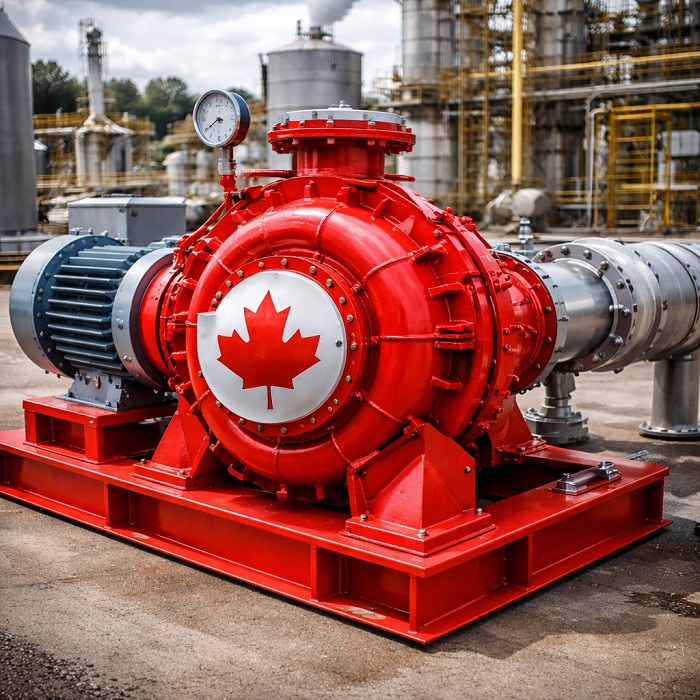
Centrifugal pumps use rotational energy to move fluids through a system. Their common applications are in settings that require steady flow and moderate pressure.
Typical applications include:
- Water transfer and circulation
- Chemical processing with low to medium-viscosity fluids
- Cooling and heating systems
Their simple design supports consistent operation and easier maintenance.
2. End Suction Pumps
End-suction pumps are a standard centrifugal pump design. Fluid enters through one end and exits at the top.
These pumps are often selected for:
- General industrial services
- Process water system
- Transfer applications with limited space
Their compact footprint makes them suitable for installations with straightforward piping layouts.
3. Split-Case Pumps
Split-case pumps divide the casing horizontally or vertically, allowing access to internal components without disturbing pipe connections.
Standard applications include scenarios where:
- High flow rates are essential
- Long operating cycles are expected
- System reliability is critical
The balanced design of these Canadian industrial pumps supports efficiency and longer service life.
4. Vertical Inline Pumps
Vertical inline pumps align the suction and discharge connections on the same axis. This configuration reduces floor space requirements.
Common uses include:
- HVAC circulation
- Industrial water distribution
- Process support systems
Their vertical orientation simplifies alignment and supports cleaner installations.
5. Diaphragm Metering Pumps
Diaphragm metering pumps deliver precise, repeatable flow rates. Their common applications include settings where controlled chemical injection is non-negotiable.
Key advantages include:
- Consistent dosing accuracy
- Compatibility with a wide range of chemicals
- Controlled flow under varying pressures
These pumps support process stability and compliance.
6. Gear Pumps
Gear pumps use interlocking gears to move fluids through the system. They are suitable for higher-viscosity applications.
Typical applications include:
- Lubricants and oils
- Polymers and resins
- Process fluids requiring steady flow
The design of these industrial pumps in Ontario provides a predictable output under stable conditions.
7. Lobe Pumps (Food-Grade Applications)
Lobe pumps move fluids using rotating lobes that create cavities within the pump chamber. Food-grade lobe pumps are a standard choice where product integrity and hygienic handling are must-haves.
The common applications include:
- Food and beverage processing
- Applications requiring clean-in-place procedures
These pumps support hygienic operation while maintaining consistent flow.
8. Drum / Barrel Pumps
Drum pumps, also known as barrel pumps, transfer fluids from drums, barrels, and totes.
They are common choices for applications such as:
- Chemical handling
- Additive transfer
- Process fluid dispensing
These pumps enhance safety and control during fluid-handling tasks.
9. Booster Pump Systems
Booster pump systems combine pumps, controls, and accessories to increase system pressure.
These pumps stand out as a preferable choice when:
- Consistent pressure is essential
- Demand fluctuates during operation
- System performance needs stabilization
Pre-engineered systems simplify installation and integration.
10. Vertical Turbine Pumps
Vertical turbine pumps work well in applications where fluids must move from deep sources or sumps. The pump assembly is installed vertically, with the impeller submerged below the fluid level.
These pumps are commonly used for:
- Industrial water intake systems
- Process water supply
- Applications with limited floor space
The vertical configuration supports stable operation in systems with varying suction conditions. This pump type is often selected where consistent flow and long operating cycles are essential.
Key Considerations When Comparing Industrial Pump Types
Selecting the right industrial pump involves more than matching flow rates. Important factors include:
- Fluid viscosity and chemical compatibility
- Required flow and pressure conditions
- Operating temperature ranges
- Maintenance access and service intervals
- System layout and installation constraints
Careful evaluation supports efficient performance and long-term reliability.
Understanding industrial pump types helps manufacturers make informed equipment decisions. Clear requirements, accurate specifications, and application-specific selection reduce operational risk.
Selecting industrial pump types aligned with system requirements supports long-term reliability. Application conditions, fluid characteristics, and operating demands all influence performance. Industrial pump suppliers provide technical insight that supports accurate equipment selection. This supports application review and pump selection based on system requirements.